Monday, 16 June 2014

Short Film Edit Review

Review of Missing In Action Edit
Editing Technology

Editing the short film is done on Adobe Premier Pro. Premier Pro is an editing program (Software) it can be used to edit a range of things such as; Short Films, Feature Films, Montages and Music Videos. Premier Pro is a great program to use for editing as it has a very organised layout and isn't too confusing to use.


Doing a Short Film edit on Premier Pro starts firstly with capturing the footage you have filmed doing the production process, to get to the capture screen you can either go to File < Capture or press 'F5'.


Once you get onto this screen, using the top box on the right-hand side select where you want the footage to be saved, then in the boxes underneath name the tape and clips. The last thing you do before the edit begins is, make sure the scene detect box is ticked, meaning it will know when to cut each clip.
 
Once the clips have captured, the next thing to do is organise the clips into bins (folders) this makes it easier to find the necessary clips for each scene.


You create bins in this area of the program, you create a new bin by clicking the folder icon at the bottom of it.

 
As also seen in the image above, making a short film edit easier instead of working on one sequence create a new sequence for each scene.
 
Editing Process & Post-Production Tools

Starting the edit process begins with putting the clips into their sequence. Then use the Razor Tool to cut the clips to be edited together in linear and understandable order. Missing In Action is a voiceover-based story which means editing the voiceovers into the sequences.


I edited the voiceovers on in two different ways. The first I ungrouped the scenes that were going to be used in the voiceover, this means I can edit both the visual and audio seperately, to do the voiceover I deleted the audio track and replaced it with the voiceover. The second way was to put the voicover on the sequence and edit the visuals of the needed clips over the voiceover.


After completing all of the scenes, the sequences are saved on the clips window then from there I put them into the master sequence.


After having all of the scenes put into linear order on the master sequence, the offline edit is complete. After this I put on the opening credits, end credits, transitions, music and cinemascope. This makes it an online edit. To create credits/titles you go to Title<New Title then opening credits is <Default Still and end credits are <Default Roll.


After clicking which you want this window will open, it should be automatically set to the standard size of your video so from this just give it a name then click 'OK' after this it comes up with a new window where the title is created.


After creating the titles the music was put into the sequence, the music was the most difficult part of the edit as it was very hard to fit the volume keyframes over the film without it being too loud over the top of the speech's.

Overall Quality of Finished Product

The final cut of the film had both it's ups and downs. The pro's of the film were the credits looked good opening and end. Most of the edits cut together well and the explosion effect looked to standard for a first timer.

The cons of the edit were in some scenes the sound was too up and down due to background noises such as the vehicles in Scene 4. Putting the cinemascope in was an issue for some of the scenes as the shot sizes made it so we had to lose something kind of important in a shot.

Putting the film together as a whole went well as it the film makes sense and nothing in it is too confusing or mis-understandable.


Thursday, 22 May 2014

Poster Review

After doing all of my practising for the poster, DVD Sleeve and DVD Label and finished filming the production I began my poster for it. My first idea for the poster was:
This didn't go as very well planned, although it looked good at first, I got carried away with the lighting on the picture which ruined it but before I actually decided it was ruined I had saved the picture, then we had decided the background was too much so changed that in the final poster.

 
My final poster seen the background change happen, the image of Vera (Maddie) change, the font colour change and the credit block added.
 
The changes to the poster give it a much more effectiveness as the image of Jack never had to change as it shown his character very well. The new image of Maddie works better as it shows her in character more both images giving an affection look and also Maddie's image doesn't take up as much of the poster as it did previously. The background doesn't get as much in your face.
 
 
The DVD sleeve mainly advertised Jack as he is the star factor character of the front cover and is on every clip scene shown on the back cover. It took a lot of development as some images just didn't work. I feel as the sleeve is effective for the film as it shows the character/s and the images doesn't give a lot away about the film.
 

The DVD Label never had much detail in it as I felt like their was too much going on already with the poster and DVD sleeve. To compensate for the lack of image I made sure to keep the DVD have the colour scheme of war/army colours.

To summarise I feel as my Poster, Sleeve and DVD advertised the DVD well enough without giving anything away from the film.


Tuesday, 20 May 2014

Me & My Movies

Me & My Movies
Action

Active vs Passive Spectatorship
Action films tend to have a passive spectatorship because when people watch them they don't think "oh how did they do that" or "That's so fake" they just take in what they are seeing and don't question things such as the White house being blown up or vehicles transforming.

The two films I'm going to be talking about are Never Back Down (2008, starring Sean Faris, Amber Heard and Cam Gigandet) and Pain & Gain (2013, starring Mark Wahlberg, Dwayne Johnson and Anthony Mackie). Both of these films fit into the action genre because they involve a person/group of people facing a challenge, fight scenes and in Pain & Gain there is explosions. 

The spectatorship for both these films is passive although for Pain & Gain some people could view it as active since it is based on a true story so it makes people question if bits of it are actually true or not. Never Back Down on the other hand is fully a passive spectatorship as there is nothing in it too over the top for people to question.

To summarise most Action films are for a passive audience but depending on how deep the story becomes some people could view them as active spectators.

Fandom
Some action films do have fandoms such as Dark Knight but then others such as Never Back Down and Pain & Gain don't have a fandom because there isn't anything very significant about them for people to go fanatic about.

Frameworks of Interpretation
Action films can be interpretated in different ways depending on who the audience is. Teens and Young Adults can get very energetic over action films, but more older mature adults either don't really enjoy action films depending on how cheesy they are or they enjoy them but don't get energetic and hyper over them.

Never Back Down is one of the films that can get people energetic and hyper because it's very high on fighting scenes whereas Pain & Gain tends to just keep you on your toes because you never know what's going to happen next with the trio.

Intertextuality
Action films don't really use intertextuality references unless they are referring to other action films, an example of this could be in The Expendables 2 since the cast are all famous for various different action films, each actor makes a quote from there most popular action films making the intertextual reference to the other film.

Media Literacy
In action films if you're educated with the behind the scenes of films you can't really view them the same because you're always analysing things in them like the effects and how the unique styles of camera work are used.

Social Networking
Action films now always have a Facebook page & Twitter Account to advertise them and give sneak peeks which is a great way of promoting the films because people who want to see little tid bits before the film is released will like the page or follow the account giving the film more promotion.

Conditions of Reception
Action films are the better films to watch in the cinema 3D or 2D because it grasps you more into the action that it would sitting watching it on a much smaller screen at home. Other genres such as romance don't really make a difference but a genre like action makes a big difference from being on the big screen compared to the small screen.

Pre & post-viewing Experience
Action films can be seen much differently from Pre & Post-viewings because watching all of the trailers, sneak peeks & interviews before seeing an Action film can make you think, "Wow this film looks so great and highly action-packed" but then when you watch the full film you realise that all the clips you seen that made it look action-packed were all the action scenes in the film.

Conclusion
To conclude Action genre films are the kind of films where if you want to view them you must WANT to view them because if you're watching them without having the intention of enjoying them you most certainly won't. I enjoy all kinds of Action Films but less preferably Super Hero films because they seem very cheesy.


Monday, 19 May 2014

File Formats

Printing Poster Graphics

Are you a budding film maker? Do you want a poster for your film? In this article I'm going to be teaching you about the different files & formats that you will need to make a poster.

Formats

First lets talk about the 2 different formats you will need and which applications these formats are on. Lets start with Vector Graphics, Vector Graphics are images that use lines, curves, shapes and polygons to create their images. These mean that the image can be expanded and shrunk without losing the image quality.

Vector Graphic Applications

There are a variety of different Vector-based Applications. I will not be talking about all of them but just to name a few, first and maybe the most popular Adobe Illustrator with it's many different tools, Illustrator can be used to make very high detailed graphics:


Formats (cont.)

 If you don't want to spend a lot of money on getting Adobe products there are others such as Inkscape or Xara photo & Graphic Designer & Macromedia Free Hand just to name a few. All of these programs use Vector graphics so can all be used the same way.

The other format is Raster Graphics this means that digital camera photos or photos from the internet which are made of pixels, these are also referred to as bitmaps. Also the larger the image the memory it will take when being saved.

Raster Graphic Applications

The same as Vector Applications there are a variety of Raster-based applications. The first is another adobe program, Photoshop there is a lot of different tools on Photoshop giving you endless options for your images.


Other options for Raster programs if you don't want Adobe software are; MS Paint, GIMP or Painter. They all do the same as Photoshop but with a lot less tools to work with.

File Extensions


When it comes to programs such as Photoshop there are a lot of different ways to save files, although you need them all here are some examples of the extensions you will need for creating DVD images:

  • .jpg (JPEG - Joint Photographic Experts Group) this is used for Digital images from Cameras or the internet.
  • .tiff (Tagged Image File Format) this is used for images that will be desktop published.
  • .png (Portable Network Graphics) this is used for palette-based images.
  • .gif (Graphics Interchange Format) this is used for short animations.
  • .bmp (Bitmap) This is used to save bitmap digital images.
  • .RAW (RAW) This is a camera image that has minimal processed data.
  • .psd (Photoshop Document) This is a saved Photoshop document that keeps all layers separated so it can be opened and edited another time.
  • ai (Adobe Illustrator) This is used to save Illustrator files that can be edited when re-opened and vector files that can be exported from Illustrator to Photoshop.
Metafiles

Finally metafiles, these are a piece of graphical information that is stored in a format that can be exchanged between different software.


Monday, 21 April 2014

Remaking Movies-Total Recall

Remaking Movies
Total Recall


Total Recall tells the story of Douglas Quaid/Hauser a man who's really not enjoying the route is life is going in and discovers a place called Rekall, a place where you can have false memories, live the life you want. He goes to Rekall to find himself already in false memories and see's his real life a secret agent in a war he doesn't know which side he is on.

The original Total Recall was realised in 1990, starring Arnold Schwarzenegger as Douglas Quaid/Hauser. In this Douglas' memories take him to Mars as a secret agent. In 2012 the remake of Total Recall see's Colin Farrell taking the role of Douglas Quaid/Hauser although  in this his memories don't take him to Mars they instead keep him on Earth. Many people including myself thought casting Farrell to take a role once done by Scharzenegger was a bad idea, Scharzenegger done a great job of the 1990 original another wasn't necessary, proving us wrong, on it's US opening weekend Total Recall 2012 had a grossing of  $25,577,758 after working with a budget of $125 million. The 1990 Total Recall had a grossing of $25,533,700 on it's opening weekend after working with a budget of $65 Million.


Total Recall 1990 was directed by Paul Verhoeven previous to Total Recall another successful film directed by Verhoeven is Robocop, after Total Recall he then went on to direct Basic Instict & Starship Troopers plus others but these were the most successful. Total Recall 2012 was directed by Len Wiseman who also directed the Underworld Saga and Live Free or Die Hard but is yet to direct since Total Recall. You can see in both of the Total Recalls more the original that both directors put their own flavour into them.Verhoeven's trio of Robocop, Total Recall and Starship Troopers are all based in the future and use a similar styling. Another common thing with Verhoeven is Total Recall and Starship Troopers are both based on other planets. Where with Wiseman Underworld isn't based in the future but Total Recall is, you can still see his frames of work within the both films.


An iconic scene from the original see's Quaid meeting a three-breasted lady, this became one of the most remembered and loved scenes from the film which just meant Wiseman couldn't leave her out giving the three-breasted lady her moment in the film.

Although Wiseman's Total Recall is a remake of Verhoeven's being that the casting is totally different to the original and it being based on Earth not Mars, you get two "totally" different feels from the each of the films. Verhoeven's gives the full on Sci-Fi action feel where Wiseman's gives a full on action feel with futuristic settings.

In Total Recall Quaid's wife as portrayed by Sharon Stone in the original and Kate Beckinsale in the remake have also both been a part of both directors other successful films, Stone in Basic Instict and Beckinsale in Underworld. Both directors used their films main characters actors who were at the top of their game at the time of their respective films, taking the role of the Resistance Leader in the original is Marshall Bell who was fresh off Twins another film starring Scharzenegger in the remake the role was given to Bill Nighy who had previously starred in Underworld and was fresh off Wrath of the Titans. The role of Vilos Cohaagen the Colony Leader was given to Ronny Cox in the original who was fresh off Loose Cannons and Captain America, in the remake the role was given to Bryan Cranston who was in his final run of his most known role in Breaking Bad. Finally the role of Melina the love interest of our protagonist was given to Rachel Ticotin in the original who was just starting her filming career with only three previous films done, in the remake we see Jessica Biel as Melina who had just finished with New Year's Eve.

To conclude both films are differently the same, following the same story but expressing them in different ways, both films were strongly cast and all of the cast in both films gave of great characteristics of the same characters. Watching both films and knowing the directors other films you see that the same story can be told in different ways and still give off the same emotions at the end of the film.


Friday, 14 March 2014

Auteur Theory (Wes Anderson)

Auteur Theory
What is Auteur Theory?
Auteur Theory is when a director uses the same style throughout all of their productions such as; Camera Angles (Over The Shoulder, Birds Eye, Close up etc.) Film Features (Slow motion, bouncy etc.) Actors.

A lot of directors could be considered Auteur's, the one I'm going to be writing about is the unique Wes Anderson.

Wes Anderson an Auteur?
                                                      
Wes Anderson is a Texan Director, he is 44, born May 1st 1969, Houston, Texas. He is most known for his unique style with films, Anderson's film career began in 1992 with the short film "Bottle Rocket" he co-wrote it with Hollywood actor Owen Wilson. Bottle Rocket then went on to become a feature film in 1996 beginning Anderson's professional film career. From then to now Anderson's filmography goes: Bottle Rocket (1996), Rushmore (1998), The Royal Tenenbaums (2001), The Life Aquatic with Steve Zissou (2004), The Squid and The Whale (2005), The Darjeeling limited (2007), Fantastic Mr Fox (2009), Moonrise Kingdom (2012), The Grand Budapest Hotel (2014).

The two films I'm going to be using to find comparisons for Auteur are The Royal Tenenbaums and Rushmore.
The Royal Tenenbaums Trailer


Rushmore Trailer


Camera Angles/Shots
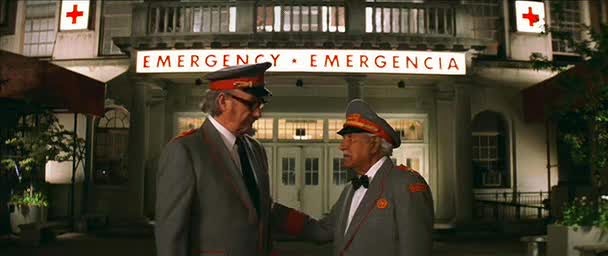
An occurring camera shot used throughout The Royal Tenenbaums is a two shot close-up/mid shot here are some examples of these:
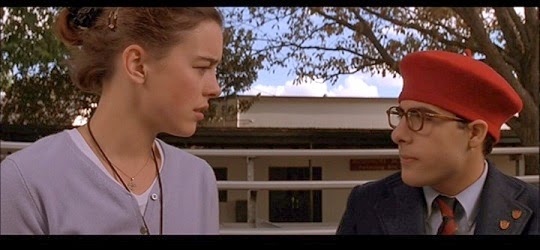
Rushmore two shot close-up/midshots:
These are just some examples of shots that Anderson uses in his films another is birds-eye view. In The Royal Tenenbaums he uses the angle on the very first scene, on Rushmore he uses the angle in a scene where Bill Murray's character 'Herman Blume' is diving into his swimming pool at his Son's party.

Another shot style that Anderson likes to use in his films is slow motion. In The Royal Tennenbaums we see slow motion when the family is reunited and Margot and Richie see each other:
In Rushmore we see slow motion when Max and Herman are sabotaging each others lives:
http://www.youtube.com/watch?v=zh04EaZQs0U
(The video I found on youtube isn't on the blogger search)

Another visual style Anderson uses throughout his films is the mise-en-scene colour palette as the two shot images show above he uses colours like; Red, Yellow & Grey in costume and dusk colours in the background/setting.

Something repetitive you see in most of Anderson's films are the actors used the 3 main actors in a lot of his films are:
Bill Murray


Owen Wilson


Jason Schwartzman


Not only is Owen Wilson a recurring actor in Anderson's films but his old time friend also co-wrote Anderson's first three films.

This is the point where a lot of people would argue that yes these are some similarities in Anderson's films but each of Anderson's films are different so does that really make him an auteur?

I'd say yes Wes Anderson is an auteur although every one of his films are different they all have similarities I only used 2 examples in this but in every one of his films you will see the same things: Mise-En-Scene Colour Palette, two shot close ups & mid shots, slow motion and actors. Just to show this here's another example Moonrise Kingdom:
Actor, Jason Schwartzman


Bill Murray


 Also in the above images you see the colour palette, with the bright yellow scarf and dusk yellow tents in the background of Schwartzman's scene and the yellow and scarf and red raincoat on the character in Bill Murrays plus the dusk background and two shot mid shot. Finally a slow motion scene from Moonrise Kingdom:
@0.40


To finalize I do feel that Wes Anderson is an auteur everything about his films show that he is.


Wes Anderson Information
Rushmore Trailer
Royal Tenenbaums Trailer
Royal Tenenbaums two shot close-up image
Royal Tenenbaums two shot mid shot image #1
Royal Tenenbaums two shot mid shot image #2
Rushmore two shot mid shot image #1
Rushmore two shot mid shot image #2
Rushmore two shot close-up image #2
Royal Tenenbaum Slow Motion
 Bill Murray Image
Owen Wilson Image
Jason Schwartzman Image
 Jason Schwartzan Moonrise Kingdom Image
Bill Murray Moonrise Kingdom Image
Moonrise Kingdom Slow motion

Tuesday, 25 February 2014

Archie's Final Project Review

Archie's Final Project was a unique film although I never enjoyed it it had its positive aspects. The film was about the life of Archie Williams and his journey to suicide. We first see Archie it small segments talking about commiting suicide. After he announces his film at school, it gets other people involved the girl he dreams about Sierra Silver joins him in the journey. After it goes to far and another student ends up killing themself it makes Archie think twice about it.

For me the film didn't have a sole purpose of entertainment but is made more to show Suicide awareness, in that I like the idea of the film, but watching it from an entertainment point of view I found the film to have lack of entertainment. It was quite a grim film I don't think I'm going to watch it again and I wouldn't recommend it to anyone unless for a Suicide Awareness programme.